Got this camera?
Sell it with us.
Free appraisal in 24 h, payment in 48 h and free shipping. We inspect it, refurbish it and give it a second life.
Inspected at 28 points by our technicians. Every unit is unique. More details
Subscribe and save on your order
Get a discount code by email.
Thanks for subscribing.
Use the code at checkout:
CAMERAMARKET10
Protect your purchase for longer.
Your camera ships with 6 months of coverage included. Extend it if you want professional photographer peace of mind.
Units sold for parts do not qualify for extended warranty.
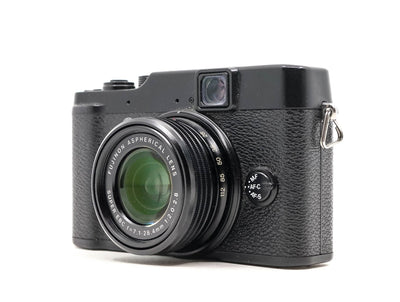
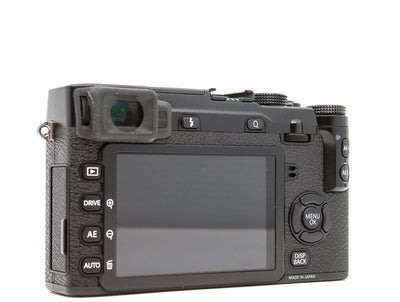
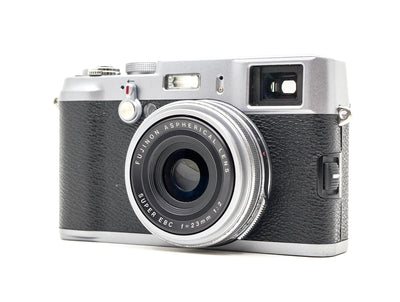
View warranty terms and conditionsThe Fujifilm X20 was introduced in January 2013 as the successor to the X10 and as an "enthusiast" compact: designed for those who want physical manual controls, real dials, and build quality in a large pocket-sized body, not for those seeking the shallow depth of field of a larger sensor. Its retro rangefinder aesthetics and mechanical zoom ring place it in the same conversation as the Sony RX100 II or the Nikon Coolpix A of its time.
Under the hood, it mounts a 2/3" X-Trans CMOS II sensor with 12 MP, no low-pass filter, and phase detection on the sensor, which also corrects the "white orbs" highlight defect that plagued the X10. The lens is fixed: a very bright 4x zoom equivalent to 28–112 mm (f/2–2.8), with macro down to 1 cm and optical stabilization that allows sharp handheld shots down to ~1/8 s.
It lets you shoot street, travel, and difficult light with total control and a real optical viewfinder with no lag. In return, it's honest to acknowledge its limitations: small sensor with little bokeh, viewfinder that only covers 85%, fixed 2.8" screen, and modest video. It's a camera to enjoy the process, not a spec-sheet all-rounder.

Read more Read less
The Fujifilm X20 is a high-end compact digital camera that combines a classic rangefinder-style design with intuitive manual controls. It belongs to Fujifilm's X series, known for its image quality and retro aesthetics, ideal for photographers seeking a lightweight and versatile camera for daily use or travel.
Key Features
- 2/3-inch CMOS sensor with approximately 12 megapixels resolution.
- Fujinon 28-112mm equivalent zoom lens (4x) with maximum aperture f/2.0-2.8.
- Full HD 1080p video at 60 fps.
- Hybrid optical viewfinder with data overlay.
- Released in 2013, representing the evolution of the X10.
Ideal for
Perfect for photography enthusiasts who value portability without sacrificing manual controls and a fast lens. It is also an excellent choice as a secondary camera or for those who appreciate the classic design of street cameras.
Condition
Second-hand product inspected by Camera Market. Includes standard 6-month warranty and 24-48h shipping from Barcelona.
Can I change the lens?
No. The X20 has a fixed lens: the 28–112 mm f/2–2.8 zoom is the one it comes with and does not accept interchangeable lenses. It does accept front accessories via thread (filters or lens hood via adapter), but not another lens. If you want to change lenses, you need a system camera, not this one.
How is the battery and how long does it last?
It uses the NP-50 battery and offers about 270 shots per charge (CIPA), just enough for a full day. It's almost mandatory to carry a spare. Using the optical viewfinder instead of the screen helps stretch it. The NP-50 is shared with other Fujis; if you opt for third-party compatible batteries, confirm they are marked as equivalent to Fujifilm's NP-50 before buying.
Is it good for video?
It records Full HD 1080p at 60 fps, but video is secondary: continuous AF jumps when panning or zooming, exposure is stepped, clips last up to 14 minutes, and there's no external microphone input. For occasional video it works; as a primary video camera, it falls short.
Is it good for starting in photography?
It can be if you're drawn to learning with physical manual controls: it has real dials and exposure compensation that teach you to understand exposure. However, it doesn't give the background blur of a larger sensor, and noise appears at high ISOs. If you want maximum image quality or pronounced bokeh, consider a larger sensor.
What should I check when buying it second-hand?
Test the zoom ring, which also acts as the power switch: it should turn on smoothly and rotate without roughness or noise. Look for dust spots by shooting at a clear sky at f/8, check for dead pixels on the screen and viewfinder, and ensure the eye sensor switches well between them. Confirm the battery holds a charge and ask if it includes the charger, cap, and strap, which are often missing.
Is it the same as the X10, X30, or X-T20?
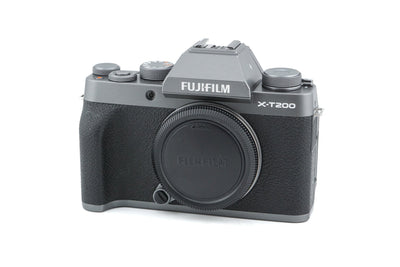
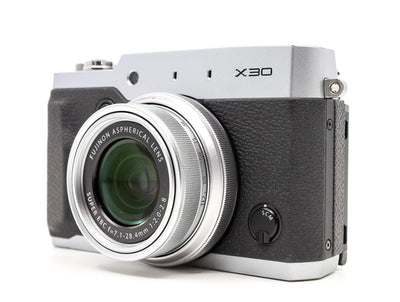
No, it's important not to confuse them. The X10 is the previous model (EXR sensor and with the white orb defect that the X20 corrects). The X30 is the 2014 successor, with an electronic viewfinder and WiFi. The X-T20 is a different line: an interchangeable lens camera. The X20 is the fixed-lens compact with an optical viewfinder.
Does it have WiFi or wireless connectivity?
No. The X20 does not include WiFi or Bluetooth, so photos are transferred via an SD card reader or cable. This is something to consider if you value immediate transfer to your phone; if that's a priority, the successor X30 did add wireless connectivity.
To complete it, take a look at spare batteries, memory cards, or camera cases.
Full condition scale
Each unit is inspected at 28 points and graded honestly. Here's how we translate each level so you know what to expect:
Barely any signs of use. Almost flawless aesthetics and perfect operation.
Light marks from normal use. Optically clean and fully functional.
Visible signs of use (scuffs, marks, brassing). Works perfectly.
Not guaranteed for use: sold for parts or repair.
Why buy used?
Depreciation is already absorbed: the same gear for much less than new.
Many classics and discontinued gems only exist today on the used market.
28-point inspection and 6-month warranty included on every unit.
Extending the life of a camera avoids manufacturing and transporting a new one.